
How to Create a Meaningful Daily Personal Ritual

Quick summary
A personal ritual is an action, or a small sequence of actions, that you choose to repeat with a particular intention. It can take two minutes, require no objects, and evolve over time. What gives it meaning is not its complexity, but the relationship you build with it.
We already have dozens of rituals without necessarily calling them that.
Making coffee the same way every morning.
Stepping outside for a few minutes before the day begins.
Listening to a song before getting on the road.
Putting on your boots and going for a walk when you need to think.
Some actions naturally become anchors.
The difference appears when we consciously decide to give them an intention.
That is when an ordinary habit can become a personal ritual.
What is a personal ritual?
A personal ritual is an action we repeat because it represents something to us.
It can help begin the day, mark a transition, return to calm, prepare to create, reflect on an intention, or simply take a few minutes for yourself.
Unlike a routine, a ritual is not only about completing a task.
It adds meaning to the action.
Drinking a glass of water is a habit.
Drinking it every morning near a window while taking a minute to decide how you want to enter the day can become a personal ritual.
A personal ritual does not need to be spiritual
The word “ritual” can sometimes make it sound as though something mystical is required.
It is not.
A ritual can be very practical.
Walking for ten minutes after work.
Writing one sentence before starting a project.
Clearing your space before creating.
Going outside when something feels too heavy.
The symbolic dimension can be very subtle.
What turns a habit into a ritual is mainly the intention you give it. The action itself can remain extremely simple.
1. Start with what you actually need
Do not begin by choosing a candle, stone, plant, or object.
Begin with the question:
“What do I want this moment to do for me?”
Maybe you want to slow down.
Recenter yourself.
Begin the day with less rushing.
Mark the end of work.
Regain a sense of stability.
Or simply remember something important.
Intention comes before decoration.
2. Choose a moment that already exists in your day
A ritual is much easier to maintain when it is attached to something you already do.
After waking up.
Before starting work.
After lunch.
When you get home.
After putting the children to bed.
Before going for a walk.
You do not need to find another half hour in your schedule.
You can transform a few minutes that already exist.
3. Keep the ritual short enough to actually happen
Many new rituals fail for the same reason some routines do: they start too big.
Meditate for twenty minutes.
Write three pages.
Stretch.
Read.
Then prepare something special.
Very quickly, the moment meant to bring us back to what matters becomes another to-do list.
Instead, design a version that takes two to five minutes.
4. Choose one central action
Your ritual needs only one main action.
Write.
Go outside.
Breathe.
Walk.
Prepare something.
Touch an object that represents your intention.
Look at the sky.
Listen to a piece of music.
When the central action is clear, the ritual becomes much easier to recognize and repeat.
5. Add an object only if it genuinely adds something
Objects can become excellent anchors.
A stone brought back from an important place.
A notebook.
A bracelet.
A photograph.
A handcrafted creation.
But the object should not become a requirement.
Ideally, you should be able to keep your ritual even when it is not available.
If you want to choose an object for its symbolism, our guide Spiritual Protection Objects: How to Choose a Symbol That Feels Right for You explores the relationship between intention and objects.
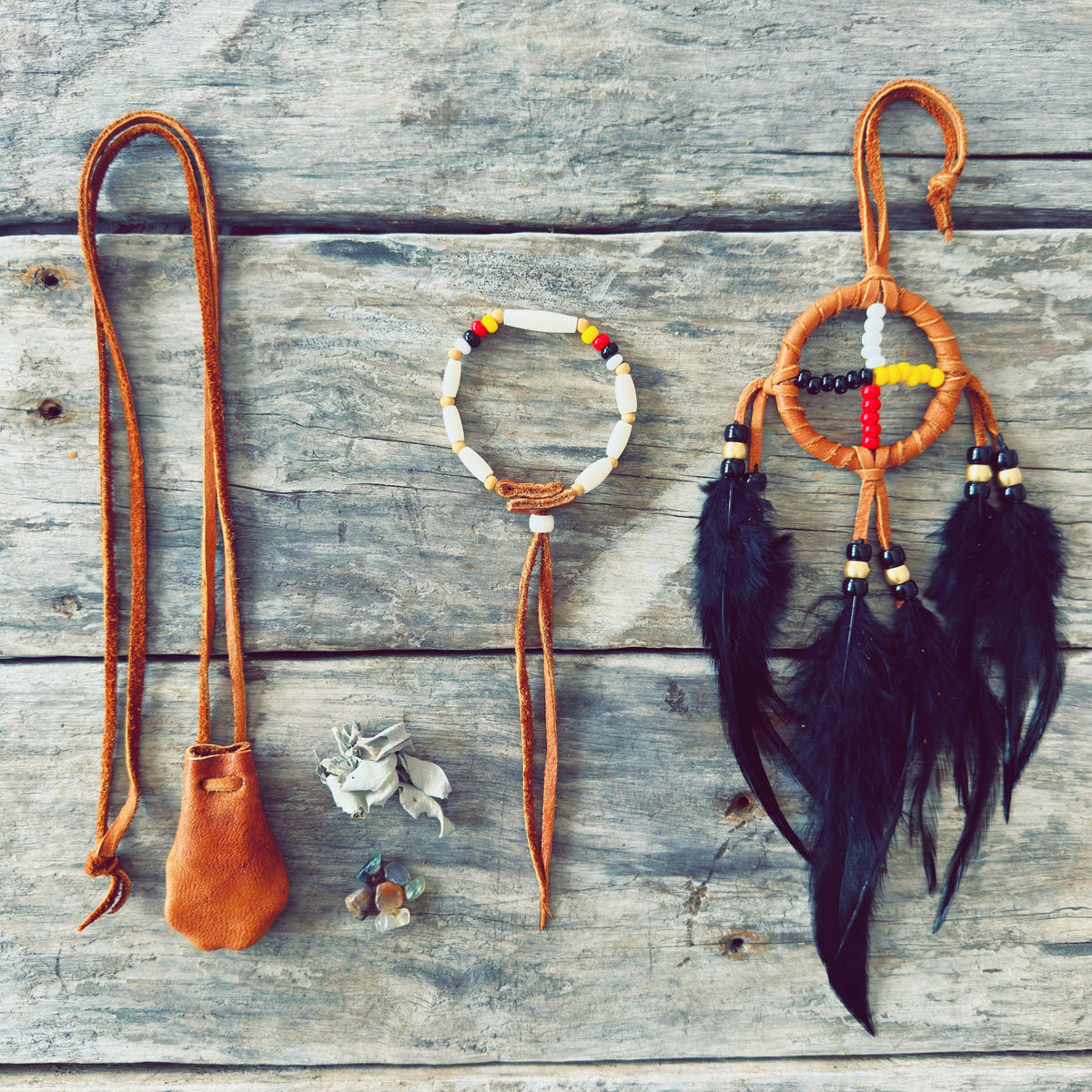
Give your intention an anchor
Equilibre – Medicine Wheel Spiritual Set
Some objects can become personal anchors when chosen with intention. The Equilibre set brings together several handcrafted creations around the Medicine Wheel and the idea of balance, encouraging an understanding of the symbol rather than simply reproducing it.
Discover Equilibre6. Give the ritual a simple phrase
Words can help remind you why you are doing this.
The phrase does not need to be a perfect affirmation.
It can be very simple.
“Today, I want to make room for what matters.”
“I can move forward without solving everything today.”
“I return to what I can actually control.”
“For a few minutes, I do not have to produce anything.”
You can also use a question:
“What deserves my attention today?”
7. End the ritual clearly
A beginning helps you enter the ritual.
An ending helps you leave it.
Close the notebook.
Put the object away.
Go back inside.
Turn off a light.
Take one final breath.
Then return to your day.
This small closing action makes the moment feel more defined.
Three examples of very simple personal rituals
A three-minute morning ritual
Open the window or step outside for a moment.
Notice the temperature, the sky, and what is happening around you.
Then choose one intention for the day.
An after-work ritual
When your workday ends, put away one work-related item.
Walk outside for five minutes, change clothes, or wash your hands mindfully.
The goal is simply to say: this part of the day is over.
A ritual before creating
Clear your work surface.
Take out only the tools you need.
Spend a few seconds looking at the materials before you begin.
Then work.
This kind of ritual often exists naturally in manual crafts: preparing your space is already part of the transition into creating.
A ritual can also follow the seasons
Your ritual does not have to remain identical twelve months a year.
In summer, you may want to go outside early.
In fall, colder weather may move the moment indoors.
In winter, light and silence may take on a greater role.
In spring, opening up the house can become part of the practice.
This relationship with the seasons also connects with slow living and a less uniform way of life.
Personal rituals and Indigenous traditions: an essential distinction
Creating your own ritual does not mean assembling different elements from Indigenous spiritual traditions.
Ceremonies, teachings, and protocols are connected to specific Nations, communities, and contexts.
A person can create a deeply meaningful personal moment without presenting it as an Indigenous ceremony.
This distinction helps maintain a more respectful relationship with traditions that are not ours to claim.
For example, the Midewiwin belongs to a specific Anishinaabe spiritual context; it is not a collection of practices to borrow when creating a personal ritual at home.
What if you use an Indigenous symbol?
Context then becomes important.
Take time to understand where the symbol comes from, what it represents, and whether it holds a particular meaning within a specific tradition.
The Medicine Wheel, for example, should not be reduced to a simple decoration vaguely representing balance.
Our article on the meaning of the Medicine Wheel and its four directions provides more context before incorporating it into a personal space.
How do you know whether your ritual is right for you?
After a few days, ask yourself one simple question:
do I want to return to this moment?
If the answer is no, simplify it.
Remove a step.
Change the time.
Remove an object.
A ritual should not become another obligation that makes you feel guilty when you forget it.
What gives a ritual meaning is not its complexity
Two minutes can become important.
Step onto the porch.
Feel the air.
Look at the sky.
Remember why you are beginning this day.
Then go back inside.
Nothing spectacular happened.
Yet you have created a small boundary between the automatic momentum of the day and a moment you actually chose.
And perhaps that is where the value of a personal ritual lies:
creating enough presence for an ordinary moment to stop passing completely unnoticed.
Discover more creations
Two handmade pieces selected from our world of creations.


