10 wild plants you encounter while hiking in the boreal forest

Quick Summary
When hiking in the boreal forest, our eyes are often drawn to tall trees, lakes, or animals. Yet, some of the most beautiful discoveries are found right under our feet. Labrador tea, sweetfern, wild blueberry, bunchberry, lingonberry, sweetgale, wintergreen, cotton grass, bog laurel, and purple pitcher plant are among these discreet plants that tell the story of the rich Quebec northern territory.
When walking in the boreal forest, we often think of black spruces, large lakes, sandy paths, rivers, and the animals we hope to encounter. We look up at the trees, listen to the birds, sometimes search for a moose track in the wet earth. Yet, a huge part of the forest's beauty lies much lower, right at our feet.
In the undergrowth, along trails, in bogs, or clearings, wild plants grow discreetly. Some give off a scent that evokes summer. Others produce fruits that feed birds, small mammals, and sometimes even bears. Some seem fragile, but they are perfectly adapted to poor soils, wet environments, and the sometimes harsh conditions of the north.
Observing these plants means learning to slow down. It means discovering that the boreal forest is not just a backdrop, but a living world full of details. Here are ten wild plants you can encounter on a boreal hike in Quebec.
Labrador Tea
Labrador tea is probably one of the most well-known plants in the boreal forest. It is found mainly in bogs, wetlands, and areas with acidic soil. Its leaves are thick, slightly curled at the edges, with an underside often brownish-orange.
Its scent is one of its most distinctive features. When passing through an area where it grows abundantly, it can release a resinous smell that immediately evokes the vast northern landscapes. Its leaves have long been used in infusions, which explains its popular name.
- Where to observe it: in bogs, wetlands, and acidic soils.
- What makes it unique: its resinous scent and leaves with a brownish underside.
Sweetfern
Sweetfern is a plant that leaves a lasting impression. In Saguenay–Lac-Saint-Jean, many associate it with warm days, forest paths, blueberry fields, and sandy soils. Simply crushing its leaves gently between your fingers releases a powerful, warm, and almost spicy scent.
It is a plant that doesn't try to impress with large, spectacular flowers. Its strength lies elsewhere: in its fragrance, in its familiar presence, in its ability to immediately evoke the Quebec summer. It is often noticed along trails, in dry and sunny spots.
- Where to observe it: in sandy soils, clearings, and along roadsides.
- What makes it unique: its very characteristic scent reminiscent of summer in the forest.
In the heart of the boreal forest, some plants remind us of the importance of staying rooted, mindful, and connected to the land

A bag inspired by roots and the forest
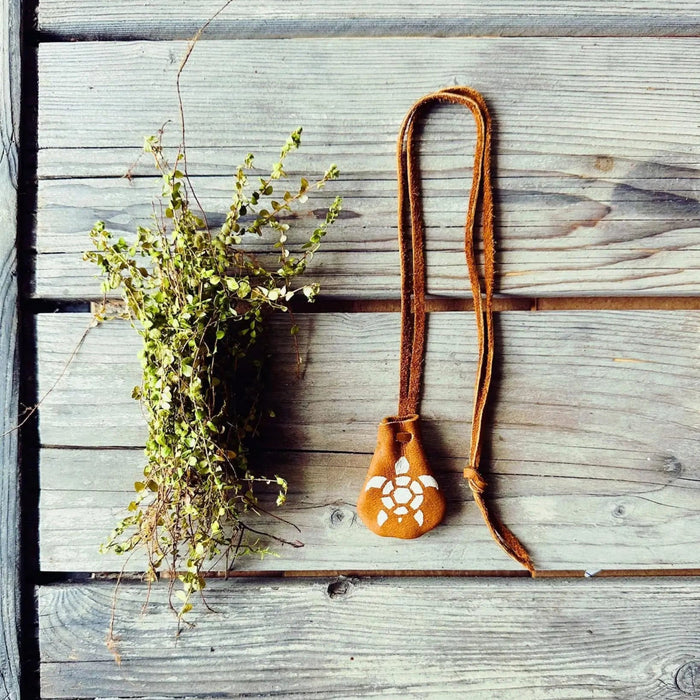
Made from 100% genuine moose hide, this medicine bag evokes an intimate connection with nature, plants, and the knowledge of the land. It accompanies those who wish to keep a meaningful object close to them, in harmony with the simple and profound rhythm of the boreal forest.
View the medicine bagWild Blueberry
Wild blueberry is deeply connected to the identity of several Quebec regions, particularly Lac-Saint-Jean. In the boreal forest, it grows in clearings, open areas, and places where light easily reaches the ground.
For humans, it is associated with summer harvests, childhood memories, and the bluish landscapes of certain northern lands. For wildlife, it also represents an important food source. Birds, small mammals, and black bears can all enjoy its fruits when the season is favorable.
- Where to observe it: in clearings, blueberry fields, and open areas.
- What makes it unique: its iconic fruits and strong connection to the Quebec territory.
Bunchberry
Bunchberry is a small, discreet, but very elegant plant. In coniferous undergrowth, it sometimes forms beautiful green carpets punctuated by white flowers. Its large bracts give the impression of a simple and luminous flower, resting near the ground.
It is mainly noticed when one takes the time to look carefully at the undergrowth. It brings a soft light to shaded areas and reminds us that the boreal forest is full of small, silent beauties.
- Where to observe it: in cool undergrowth, especially in coniferous forests.
- What makes it unique: its white flowers that illuminate the forest floor.
Lingonberry
Lingonberry is a small northern plant that produces vibrant red berries. It grows close to the ground, often in cool environments, acidic soils, and the open landscapes of the boreal forest.
Its fruits attract attention with their bright color. They are also important for several animal species that depend on small wild fruits throughout the seasons. Even when it goes unnoticed, the lingonberry participates in the forest's food chain.
- Where to observe it: in acidic soils, cool environments, and open areas.
- What makes it unique: its small red berries that are very visible in the landscape.
Sweetgale
Sweetgale is less known than Labrador tea or wild blueberry, but it is one of the interesting plants that can be encountered in the boreal environment. It often grows near wetlands, lakes, streams, or bogs.
Its leaves release a pleasant scent when crushed. It is a plant that adds to the olfactory identity of the forest, that impression that each area has its own scent depending on the soil, humidity, and surrounding vegetation.
- Where to observe it: near wetlands, lakes, and bogs.
- What makes it unique: its aromatic scent and its discreet presence near water.
Wintergreen
Wintergreen, often called "petit thé" (little tea), is a plant recognizable by its fresh scent reminiscent of sweet mint. It grows close to the ground and produces small red berries that easily catch the eye when walking slowly.
In the undergrowth, it sometimes seems to hide under branches, moss, and leaves. But as soon as you notice it, it becomes easy to recognize. Its particular smell makes it a memorable plant for those who like to observe nature up close.
- Where to observe it: in cool undergrowth, often near mosses.
- What makes it unique: its sweet mint scent and small red berries.
Cotton Grass
Cotton grass transforms bogs into almost magical landscapes. Its light, silky white tufts float in the wind and create a beautiful contrast with the greens and browns of wet environments.
When crossing a bog or a trail laid out in a wetland, cotton grass immediately catches the eye. It reminds us that the boreal forest is not only made up of trees, but also vast open environments, fragile and full of life.
- Where to observe it: in bogs and wetlands.
- What makes it unique: its white tufts that give a luminous appearance to the landscapes.
Bog Laurel
Bog laurel adds a spectacular touch of color to the boreal forest. When it blooms, its pink hues stand out strongly against the deep greens of conifers and the mosses of the undergrowth.
It is often found in acidic soils and open areas. Its flowering reminds us that even in sometimes harsh environments, the boreal forest can offer moments of great beauty.
- Where to observe it: in acidic soils, open areas, and certain wetlands.
- What makes it unique: its pink bloom that brightens the northern landscapes.
Purple Pitcher Plant
The purple pitcher plant is one of the most fascinating plants you can observe in Quebec. Unlike most plants, it is carnivorous. It grows in certain bogs where the soil is poor in nutrients, then it supplements its needs by capturing small insects.
Its cup-shaped leaves collect rainwater and trap insects that venture into them. This astonishing adaptation shows how much boreal plants can develop remarkable strategies to survive in difficult environments.
- Where to observe it: in certain bogs and nutrient-poor wetlands.
- What makes it unique: its carnivorous lifestyle and cup-shaped leaves.
Why Observe Without Disturbing
The boreal forest is a living, but also fragile, environment. Many plants grow slowly, some occupy sensitive environments, and others play an important role in animal diets. When hiking, it is therefore best to observe, photograph, and learn to recognize plants rather than picking them unnecessarily.
This approach allows you to fully enjoy nature while respecting the environment. Every plant, even the most discreet, is part of a larger balance than us. By taking the time to observe without disturbing, we develop a deeper connection with the land.
- Observe: take the time to look at plants in their natural environment.
- Photograph: keep a memory without damaging the environment.
- Respect: avoid picking a plant you don't know.
- Learn: better understand the richness of the boreal forest.
Conclusion
The boreal forest is much more than a succession of spruces, lakes, and forest paths. It is made up of a multitude of living details that are only discovered when one slows down. The wild plants that grow along the trails tell the story of the soil, water, light, and seasons.
Next time you go hiking, take a few moments to look at what is growing around you. Behind every leaf, every flower, and every small fruit lies an adaptation, a presence, and a connection to the northern territory. The boreal forest reveals its most beautiful treasures to those who take the time to observe it.
Go deeper into what you feel
Some creations naturally extend the energy of what you have just read.