
The Indigenous legend of the circle of time and the wisdom of the cycles of life

Quick Summary
In Indigenous cultures, time is perceived as a living circle, not a straight line. This legend tells the teaching of an elder explaining that nothing truly disappears: everything, from seasons to the cycles of human life, returns in a new form, offering a perspective of peace and balance in the face of the world's changes.
Context
In many Indigenous cultures of North America, time is not seen as a straight line moving forward without return. Instead, it is understood as a living circle, a movement that constantly repeats and transforms.
The elders observed the Earth to understand this movement:
- • The sun that rises and sets
- • The moon that disappears and then returns
- • The seasons that turn like a great wheel
- • Generations that follow one another
All this teaches that life moves in cycles.
It is in this spirit that an ancient story about understanding the circle of time is told.
The Legend
A very long time ago, humans were troubled by the changes in the world.
When winter arrived, they thought the warmth would never return.
When leaves fell, they believed the forest was dying forever.
A young walker decided to seek advice from an old elder who lived near a large lake surrounded by mountains.
The youth asked him:
Why do things disappear?
The elder did not answer immediately.
He took a stick and slowly drew a circle in the earth.
Then he simply said:
Look at the moon.
The youth observed the moon for several nights.
It was thin like a thread.
Then it became round and bright.
Then it disappeared into darkness.
But a few nights later, it returned.
The elder then spoke again.
Nothing truly disappears.
Everything moves in a circle.
He pointed to the forest.
Leaves fall, but the tree remains alive.
Rivers freeze, but water flows again in spring.
Animals leave the valley, but they return when the earth warms up.
Then the elder placed his hand on the young walker's shoulder.
Even humans walk in this circle.
Children become adults.
Adults become elders.
And elders become ancestors who continue to accompany the living.
The young walker then understood something profound.
Time is not a road.
Time is a circle in which everything returns in a new form.
A thought on daylight saving time
This vision also helps to reflect on modern habits.
For example, last night, clocks changed time. Modern societies move time forward or backward to adapt to human organization.
In Indigenous cultures, this practice did not exist. The rhythm of life simply followed the sun, moon, and seasons.
But this time change can still become an opportunity for reflection.
It reminds us that, even if our clocks move, the circle of nature remains unchanged. The sun will continue to rise. The seasons will continue to turn.
And life will continue its circular movement.
Conclusion
The elders said that understanding the circle of time brings great peace.
For when one understands that everything works in cycles, one ceases to fear changes.
Every end already prepares a new beginning.
Perhaps this is why many Indigenous spiritual objects use the circle shape, a symbol of balance and harmony.
Some artisans even choose to represent this idea with two linked circles, recalling the cycles that echo each other: day and night, moon and sun, dreams and waking life.
For at the heart of this teaching remains a simple truth:
Life does not walk in a straight line.
It gently turns in the circle of time.
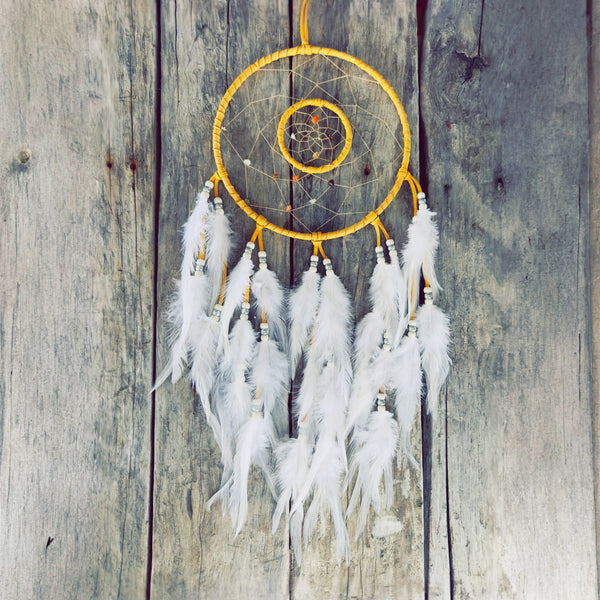
In many Indigenous teachings, the circle represents the cycle of life, balance and the movement of time. This double-circle dreamcatcher precisely evokes this symbolism: two circles linked like the cycles of nature, generations, and dreams that pass through the night.
Handcrafted from genuine moose hide and natural feathers, it acts as a symbol of protection and harmony in a resting space.
Discover more creations
Two handmade pieces selected from our world of creations.


Frequently Asked Questions
What is the indigenous view of time?
Why is the circle important in indigenous cultures?
Do indigenous peoples use daylight saving time?
- Choosing a selection results in a full page refresh.
- Opens in a new window.