
The Fire Fox – Algonquian Legend

Quick Summary
In Algonquian tradition, the fox embodies benevolent cunning and intelligence. This legend tells how, moved by the suffering of humans plunged into the cold, it braved the spirits of the sky to steal a sacred ember. Its sacrifice, forever marked in the color of its russet fur, brought light and warmth to the world of men.
The Fire Fox
An Algonquian legend of cunning, light, and transformation
Cultural Summary
In several Algonquian traditions, the fox is perceived as an intelligent, discreet, and observant being. It is neither the strongest nor the largest, but it possesses an essential quality: benevolent cunning.
Some versions of an ancient legend say that before the arrival of fire, humans lived in cold and darkness. Fire belonged to the spirits of the sky or to jealous guardians who refused to share it.
The fox, touched by the vulnerability of humans, decided to intervene.

The Legend
There was a time when night lasted longer than day.
Humans gathered in the shadows, huddled together. The cold seeped into their bones. Children trembled. Light was but a memory recounted by the elders.
Up above, beyond the clouds, the spirits held the fire.
It burned endlessly.
It illuminated.
It warmed.
But it did not descend.
The Fox observed.
He was not the most powerful of animals. He possessed neither the strength of the bear nor the wings of the eagle. But he had something else: the intelligence of silent movement.
One night, he looked up at the sky and understood that he could not wait for the light to fall on its own.
He had to take it.
He waited for the guardians to relax. He slipped into the shadows, silent as a thought. He reached the sacred fire.
The heat was already burning the air around him.
Some say he snatched an ember in his mouth.
Others say he tied it to his tail.
In all accounts, he did not flinch.
The fire bit.
His fur singed.
His tail caught fire.
But he ran.
He ran through the night, through the hills and forests, all the way to the humans.
When he placed the ember in the center of the circle, light burst forth.
Faces were illuminated.
The cold retreated.
The night changed.
Since that day, the red fox bears the mark of fire in its color.
And humans learned two things:
Light can be shared.
And sometimes, the smallest one is the one who transforms the world.
Conclusion
The Fire Fox is not just a story of theft.
It is a story of transformation.
It reminds us that intelligence can be stronger than brute force.
That light sometimes requires courage.
And that every transformation leaves a mark.
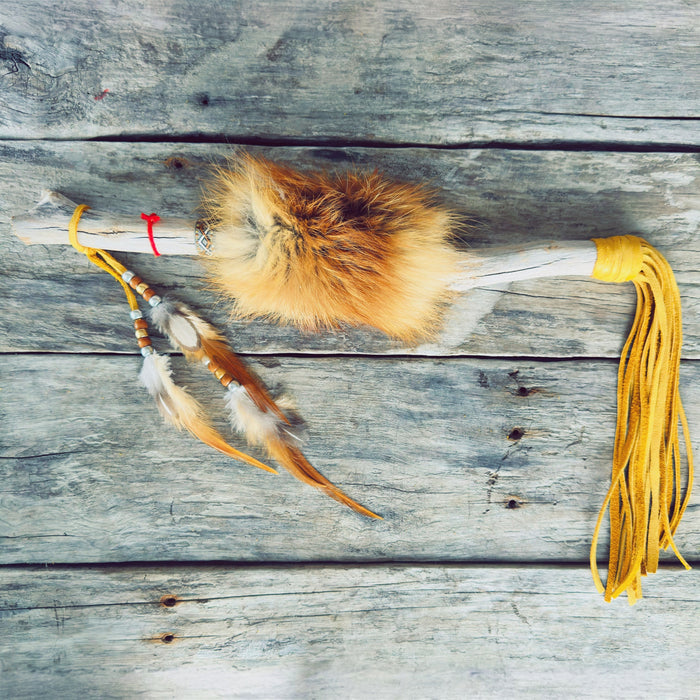
In Algonquian traditions, stories are not detached from daily life. They live through symbols, objects, and transmitted gestures.
Wearing a fox symbol, keeping an intentionally crafted object close to oneself, is not about seeking to possess fire.
It is about remembering that everyone carries an ember within them.
An ember that can illuminate, warm, and transform.
You feel a connection with this animal
Each animal carries a unique message. Deepen this connection by exploring the full meaning of animals.
Explore totem animalsGo deeper into what you feel
Some creations naturally extend the energy of what you have just read.

Frequently Asked Questions
What is the legend of the Fire Fox?
Where does the legend of the Fire Fox come from?
Why is the fox associated with fire?
- Choosing a selection results in a full page refresh.
- Opens in a new window.