
How did Indigenous people transport fire in the forest?

Quick summary
Before modern lighters, fire preservation was essential when traveling in the boreal forest. Certain mushrooms like chaga, also called "ox nose", could help keep an ember alive for several hours. This knowledge illustrates the deep understanding of fire, water, trees, and the land among many Indigenous peoples.
Chaga: The mushroom that could preserve an ember
How did Indigenous peoples transport fire in the forest? This question directly relates to the knowledge of fire and water, two essential elements for life on the land.
In Quebec's boreal forest, fire was much more than just a means of keeping warm. It was used to cook food, dry clothes, light the camp, repel moisture, and survive long, cold nights.
Before modern matches, lighters, and current camping equipment, rekindling a fire could require a lot of effort, especially in a humid, snowy, or windy environment. This is why preserving an ember sometimes became as important as knowing how to start a fire.
Transporting fire also required carefully protecting what nourished and preserved it.
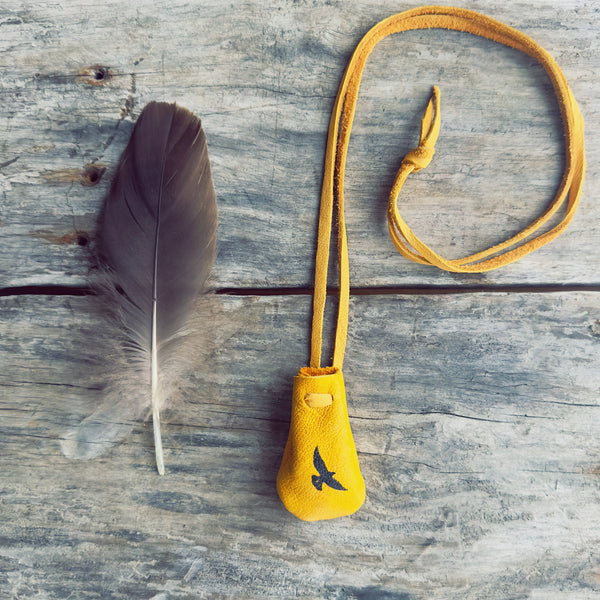
A small bag inspired by protection and vigilance
Made from 100% genuine moose leather, this medicine bag evokes the objects kept close during travels through the territory. Inspired by the eagle and its clear vision, it accompanies individuals who maintain a deep connection with traditional knowledge and the memory of fire.
See the medicine bagChaga: The birch mushroom
Chaga, also known by its scientific name Inonotus obliquus, primarily grows on birch trees in northern regions. In Quebec, it is often associated with the boreal forest, white birches, and natural knowledge related to the land.
Its appearance is very distinctive. It resembles a black, hard, and cracked mass on the outside, with an orange-brown interior. This appearance sometimes makes it look like a piece of charcoal attached to the trunk.
- Popular Name: Chaga is sometimes called "ox nose" in certain regions.
- Associated Tree: It mainly grows on birch trees, particularly in northern forests.
- Appearance: Its black crust and orange interior make it easily recognizable.
Today, chaga is primarily known for infusions and natural uses. But in fire-related knowledge, certain woody fungi like it could also be useful for preserving an ember.
Can you really transport an ember with chaga?
Yes. Once well dried, some very dense and fibrous natural materials can sustain slow combustion for a long time. Dry chaga could thus be used to keep an ember alive and facilitate rekindling a fire later.
This technique does not involve transporting a large flame. Instead, it’s about maintaining a small, stable ember, capable of burning slowly, and then being revived with dry materials such as bark, plant fibers, very dry wood, or resin.
- Slow Combustion: Dry chaga can smolder gently without producing a large flame.
- Fire Transport: A preserved ember made it easier to restart a fire at the next campsite.
- Energy Saving: This avoided having to restart the entire fire-starting process each time.
In a cold or humid climate, this knowledge could become extremely valuable, as finding perfectly dry wood was not always easy.
Why was preserving fire essential in the boreal forest?
In northern territories, fire was a condition for survival. It protected against cold, humidity, and darkness. When traveling, it could also be used to dry wet clothes, prepare meals, and make the camp safer.
In many Indigenous families and communities, fire knowledge was passed down through observation and experience. One had to know how to recognize good materials, choose the right location, protect embers from water, and understand wind behavior.
- Heat: Fire helped survive cold nights and harsh seasons.
- Cooking: It allowed for preparing food on the land.
- Drying: It was used to dry clothes, skins, boots, or certain materials.
- Protection: It lit the camp and could keep some animals away.
In many Indigenous traditions, fire also held an important place in gatherings, exchanges, and certain moments of transmission related to the territory.
To learn more about this topic, you can also read this article on the meaning of Indigenous sacred fire.
The knowledge of fire and water
Fire and water are two opposing yet complementary elements in forest life. Water is essential for survival, travel, cooking, and the life of the land. Fire, on the other hand, allows for transformation, warming, drying, and gathering.
Living in the forest thus required understanding how to protect fire from humidity, how to choose dry wood, how to keep an ember alive, and how to use natural resources even when the land was wet or snowy.
- Protecting the Ember: An ember had to be kept dry and sheltered from the wind.
- Understanding Humidity: Rain, snow, and wet ground could make starting a fire difficult.
- Reading the Land: Dead trees, dry bark, resins, and certain mushrooms could help restart a fire.
These insights demonstrate that survival in the forest was not solely based on physical strength. It also relied on attention, memory, experience, and transmission.
Knowledge related to fire was part of a much larger body of knowledge for surviving and traveling in the boreal forest.
You can also read this article on Indigenous navigation techniques in the forest using trees and natural signs.
In the territory, the drum's rhythm also reminded of the importance of staying attentive, calm, and connected to one's environment.

A drum inspired by presence in nature
Handcrafted with genuine deerskin, this drum evokes the deep connection between Indigenous peoples and forest life. Its wolf-inspired motif recalls the listening, instinct, and vigilance necessary when traveling and staying in the territory.
See the handcrafted drumKnowledge related to birch trees and the forest
Chaga also highlights the importance of birch trees in many regions of Quebec. White birch was used for numerous purposes related to life on the land, including bark, containers, shelters, crafts, some canoes, and various natural know-how.
The fact that a mushroom growing on birch could also be used to preserve an ember shows how each element of the forest could have multiple uses.
- Birch: A central tree in many forms of knowledge related to the boreal forest.
- Chaga: A natural resource associated with both trees and fire.
- Territory: Each resource was observed, known, and used according to its properties.
In the boreal forest, many natural resources such as resins, barks, and certain mushrooms played an important role in knowledge related to the land.
To delve deeper into this topic, you can also read this article on fir gum and its traditional uses in Quebec.
A survival technique still fascinating today
Today, many people are rediscovering these techniques through bushcraft, forest survival, northern knowledge, and a growing interest in Indigenous knowledge related to the land.
However, this knowledge should not be seen as mere survival tricks. They bear witness to a much deeper relationship with the forest, trees, seasons, and natural elements.
- Survival: Dry chaga could help preserve an ember when traveling.
- Transmission: This knowledge was learned through experience and observation.
- Respect: Natural resources were used with care and understanding.
Conclusion
Chaga, or ox nose, perfectly illustrates the ingenuity of knowledge related to the boreal forest. Once dried, this mushroom could help preserve an ember for several hours, allowing fire to be transported from one camp to another.
For many Indigenous peoples living near the northern territory, preserving fire was part of a set of essential knowledge related to survival, climate, trees, water, and travel.
This knowledge reminds us that the forest was not just a place to pass through, but a living world to understand. Every tree, every mushroom, every ember, and every natural element could become a teaching for those who knew how to observe.
Discover more creations
Two handmade pieces selected from our world of creations.


