
What is an Indigenous spiritual rattle and what is its real purpose?

Quick summary
The Indigenous spiritual rattle is an object of sound, movement, and intention. Present in several Indigenous cultures of North America, it serves to purify, call upon, accompany, and ground. It is neither an ordinary musical instrument nor a decorative object, but a relational tool between the body, the mind, and all living things.
What is an Indigenous spiritual rattle and what is its real purpose?
An object of vibration and presence transmitted through use and intention.
The spirit rattle is present in many Indigenous cultures of North America. It does not belong to a single nation or a uniform tradition. It is found, in different forms, in the traditions of the Anishinaabe, Cree, Innu, Lakota, and several other peoples, where sound is recognized as a living force.
In these cultures, the rattle accompanies ceremonies, songs, prayers, spiritual care, and moments of transition. It can be used by elders, knowledge keepers, and also in family and community settings.
There is no single model of rattle. Its shape, materials, and use vary according to the region, available natural resources, and orally transmitted knowledge. What remains constant is the respect shown to the object and the intention that guides its use.
The spiritual rattle is a vibrational tool
The spiritual rattle is a vibrational tool. Its role is not to produce a melody, but to generate a frequency that passes through space, body, and mind.
It works on three levels. Sound, which cleanses, calls, or stabilizes. Movement, which accompanies the circulating energy. And intention, which gives meaning to each gesture. Without intention, the rattle becomes silent, even if it makes noise.
The materials are truly important. Traditionally, rattles are made from natural materials linked to the local area: leather, fur, wood, seeds, stones, or elements of living things. These materials carry their own memory and vibration.
The rattle can be used to purify a place or a person, open or close a circle, accompany a drum, support a moment of reflection, or simply bring oneself back to the present moment. It imposes nothing. It accompanies.
Respectful usage and posture today
Today, the spiritual rattle is used in both Indigenous cultural contexts and by non-Indigenous people seeking meaning, recentering, or respectful practices.
When a non-Indigenous person uses a rattle, posture is essential. It is not about reproducing a ceremony or appropriating rituals specific to a nation. It is about engaging with the object through listening, humility, and respect.
The rattle can then become a personal tool: to mark a moment of silence, accompany an intention, support inner work or a meditative practice. The essential thing is not to "do it right," but to do it mindfully.
Respect is shown through recognition of the object's indigenous origin, the choice of authentic handcrafted creations, and a use that does not trivialize its symbolic significance.
The rattle teaches a fundamental lesson. The right rhythm cannot be forced. It is felt. It reminds us that movement and silence must move forward together.
What this object teaches
The rattle serves as a reminder that sound can become a point of reference. It brings presence back into the body and clarifies intention.
- • Sound accompanies purification and grounding.
- • The movement supports circulation and refocusing.
- • Intention gives meaning to every gesture.
Used with respect, it becomes a simple, stable, and deeply symbolic tool. The rattle is not meant to impress. It is meant to remind. To remind us of our breath. To remind us of listening. To remind us that every gesture can become a prayer when the intention is right.
The Artisan's Gallery
Discover the spiritual rattles handcrafted by Dave Verreault-Thisselmagan.
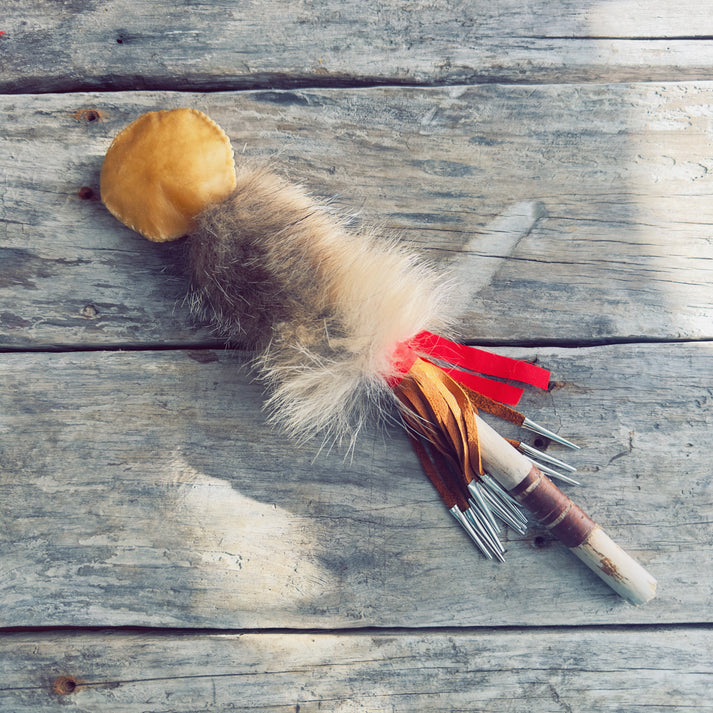
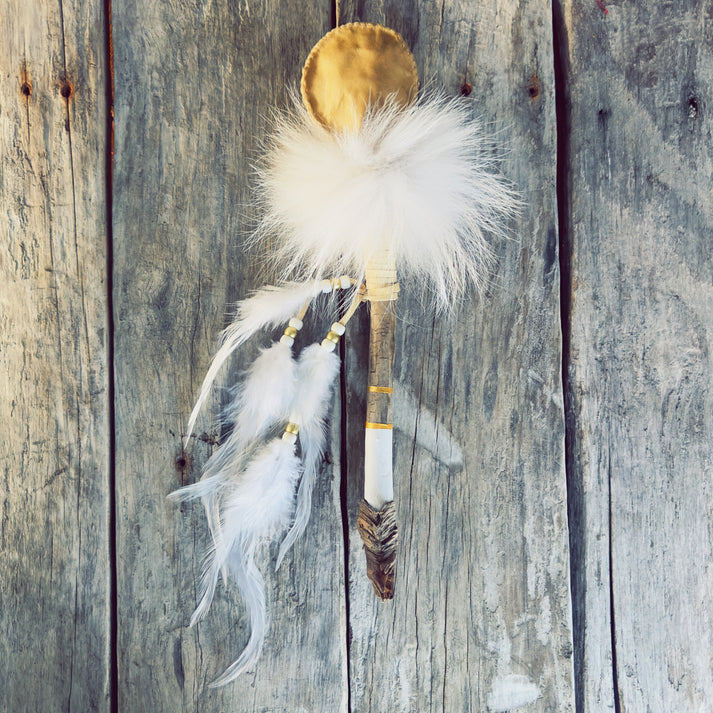
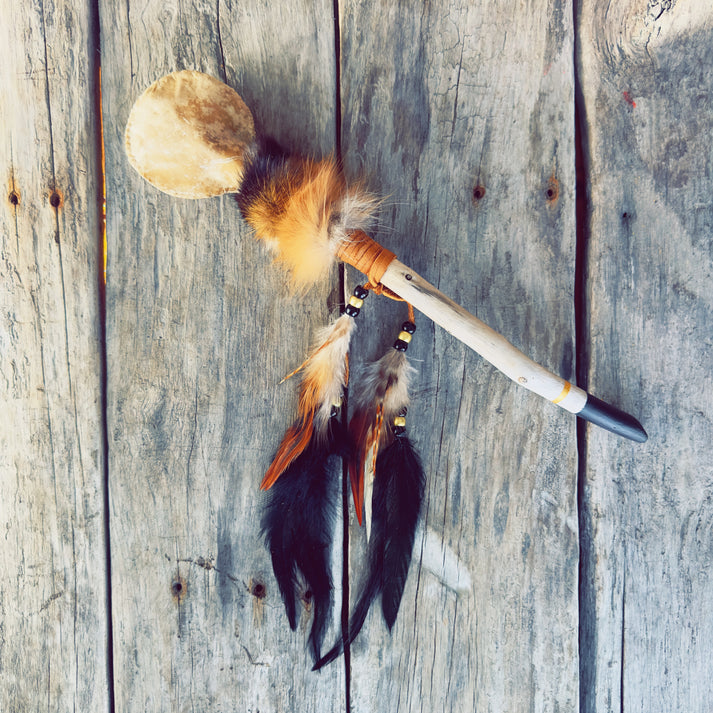
Each rattle is handcrafted on the Nitassinan by the Ilnu craftsman Dave Verreault-Thisselmagan.