
The origin of Indigenous drums and their meaning

Quick Summary
Indigenous drums are at the heart of spiritual traditions, symbolizing the heartbeat of Mother Earth and serving as a bridge between the physical and spiritual worlds.
A Beat that Connects Earth and Spirits
Indigenous drums are not just musical instruments: they are at the heart of the spiritual and cultural traditions of Indigenous peoples. Symbolizing the heartbeat of Mother Earth, they play an essential role in ceremonies, rituals, and the transmission of ancestral knowledge.
Drum Making: A Sacred Art
Each drum is crafted with care and follows an ancestral process:
- The wooden frame: often circular, it represents the cycle of life and the interconnectedness of all things.
- The animal hide: deer, moose, caribou, or bison, it is treated with respect to honor the spirit of the animal.
- The lacing: made of rawhide, it sometimes forms a cross on the back, symbolizing the balance between elements.
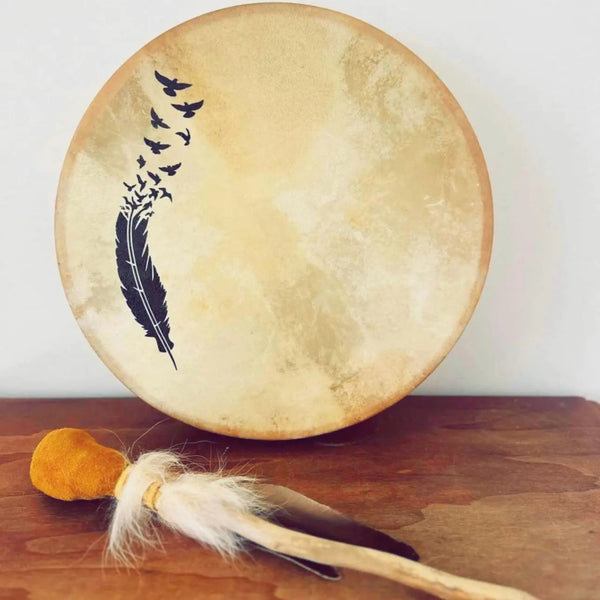
Drums that carry presence and resonance
Handcrafted creations that evoke rhythm, listening, and presence.
Strong artisanal works, designed to inhabit a space and accompany an inner journey.
See the drums
The Drum and Indigenous Spirituality
In Indigenous traditions, the drum is considered a living being, carrying spiritual energy. Its beats resonate as a call to ancestors and benevolent spirits.
Sacred ceremonies: Pow-Wows, healings, rites of passage.
Connection with the spiritual world: the drum's rhythm synchronizes the human heart with that of the Earth.
Transmission of traditional songs: each beat accompanies songs carrying stories and teachings.
An Instrument of Many Forms
The hand drum: small in size, it is often used for personal practices and rituals.
The big drum: played in groups during Pow-Wows, it symbolizes unity and community strength.
Contemporary Issues and Cultural Transmission
Today, the making and use of drums are still taught to younger generations to ensure the continuity of traditions. Respect for practices and knowledge passed down by elders remains essential.
Deepen Your Feelings
Some objects accompany an inner journey. Choose the one that resonates with your intention.


Discover more creations
Two handmade pieces selected from our world of creations.


1 comment
What does it mean when I hear drumming but there are no drumming in site?